Mondly Kids vs ABCmouse for Parents Who Want Speaking
For speaking-focused families, Mondly Kids and ABCmouse are usually support tools, not full conversation practice. Compare 4 fit signals before subscribing.
Is a mondly kids review worth it for language speaking?
Mondly Kids targets children aged 5 to 10 with basic vocabulary exercises across 33 languages, but relies entirely on manual voice repetition rather than dynamic conversational practice.
For parents evaluating if the platform justifies its cost, the decision rests entirely on whether the child needs vocabulary acquisition or active speaking practice. The application structures its curriculum around more than 50 simulated conversations and 36 specific vocabulary builders (Krioda, 2026). However, the oral component remains fundamentally static. Users must manually hold down a microphone button to repeat pre-recorded phrases, which trains pronunciation but fails to develop the cognitive pathways required for spontaneous dialogue.
Industry analysis highlights these structural limitations for older children. As noted by Test Prep Insight (2026), Mondly's speaking functionality exists "in a vacuum," testing isolated phrase recall rather than conversational agility. Furthermore, reviewers criticize the platform for providing "thin grammar instructions," which creates a ceiling for students attempting to progress beyond basic word recognition.
When analyzing cost, families have two primary subscription routes. Monthly family plans covering 2 to 6 premium accounts range from $16 to $36 per month (Krioda, 2026). Alternatively, parents frequently purchase a "Lifetime Access" plan marketed at $99.99, which provides access to 41 languages through a single one-time payment (TalkReal, 2025). This lifetime tier represents the most cost-effective entry point for multi-child households seeking foundational vocabulary exposure.
What does an ABCmouse app subscription provide?
An ABCmouse app subscription delivers foundational English literacy, math, and science modules for children aged 2 to 8, but features zero AI-powered conversational components.
Parents searching for oral English practice frequently miscategorize ABCmouse as a language training tool. In reality, it functions as a broad early childhood education environment. The platform utilizes highly structured, subject-based learning paths designed to teach native English speakers how to read, identify shapes, and understand basic science concepts. It does not employ speech recognition technology, nor does it prompt the child to generate unscripted sentences.
Because the system relies on static learning paths, it cannot correct pronunciation or respond to a child's verbal input. By current market standards, the lack of real-time feedback places the application behind modern language tools. Analysis from KidsAI (2026) describes the ABCmouse interface and underlying pedagogy as "dated" compared to platforms that integrate responsive AI features.
For families speaking English as a Second Language (ESL), the platform holds value purely for early literacy and phonics exposure. A young ESL learner will acquire sight words and basic listening comprehension through the animated lessons. However, parents expecting the software to encourage their child to speak out loud will find the application insufficient for oral fluency.
How do Mondly Kids and ABCmouse compare directly?
ABCmouse prioritizes broad early childhood literacy for children up to age 8, whereas Mondly Kids specifically targets foreign language vocabulary acquisition for ages 5 to 10.
Understanding the mechanical differences between these two platforms helps parents align their subscription choices with their child's developmental stage. Neither app serves as a complete conversation partner, but they occupy completely different segments of the educational software market.
| Feature Comparison | Mondly Kids | ABCmouse |
|---|---|---|
| Primary Target Age | 5–10 years old | 2–8 years old |
| Core Subject Focus | 33+ Foreign Languages | English Literacy, Math, Science |
| Speaking Mechanics | Manual mic-button repetition | None (Structured learning paths) |
| Vocabulary Delivery | Gamified phrase matching | Subject-based contextual reading |
| Conversational AI | Not included | Not included |
The timing of these interventions matters significantly for neurological development. Educational researchers report that the biological window for native-like language acquisition begins to narrow between ages 10 and 12 (Screenwise, 2026). Consequently, introducing the vocabulary builders in Mondly Kids or the phonetic structures in ABCmouse before puberty provides distinct neural benefits, establishing a foundation even if immediate spoken fluency does not occur.
Why do gamified apps fail to create conversation?
Gamified applications isolate vocabulary practice into rigid prompts, preventing children from learning how to actively form sentences or respond to unpredictable dialogue.
Platforms relying on "repeat-after-me" mechanics train short-term recall rather than linguistic synthesis. When a child repeats a phrase into a microphone, they are executing a matching exercise. They are not processing context, formulating an original thought, or managing the social pressure of a live interaction. This is exactly why Duolingo ABC speaking skills not designed for conversation are widely categorized as reading readiness tools rather than oral practice systems.
Active speech requires a feedback loop. A child must hear a question, interpret the meaning, construct a relevant response, and deliver it audibly. Traditional apps break this loop by providing the exact sentence the child needs to say beforehand. Without the cognitive friction of generating original sentences, the child builds a strong passive vocabulary but freezes when asked to speak in a real-world scenario.
Which is the best English app for kids to speak out loud?
The most effective speaking applications in 2026 utilize adaptive AI tutoring and real-time feedback to generate high-volume oral practice in interactive environments.
Because legacy apps lack dynamic response capabilities, the market is shifting rapidly toward artificial intelligence. For families where active speech is the absolute priority, practitioners now rank AI-first tools significantly higher than traditional gamified applications due to their capacity for real-time conversation matching (Enverson, 2026).
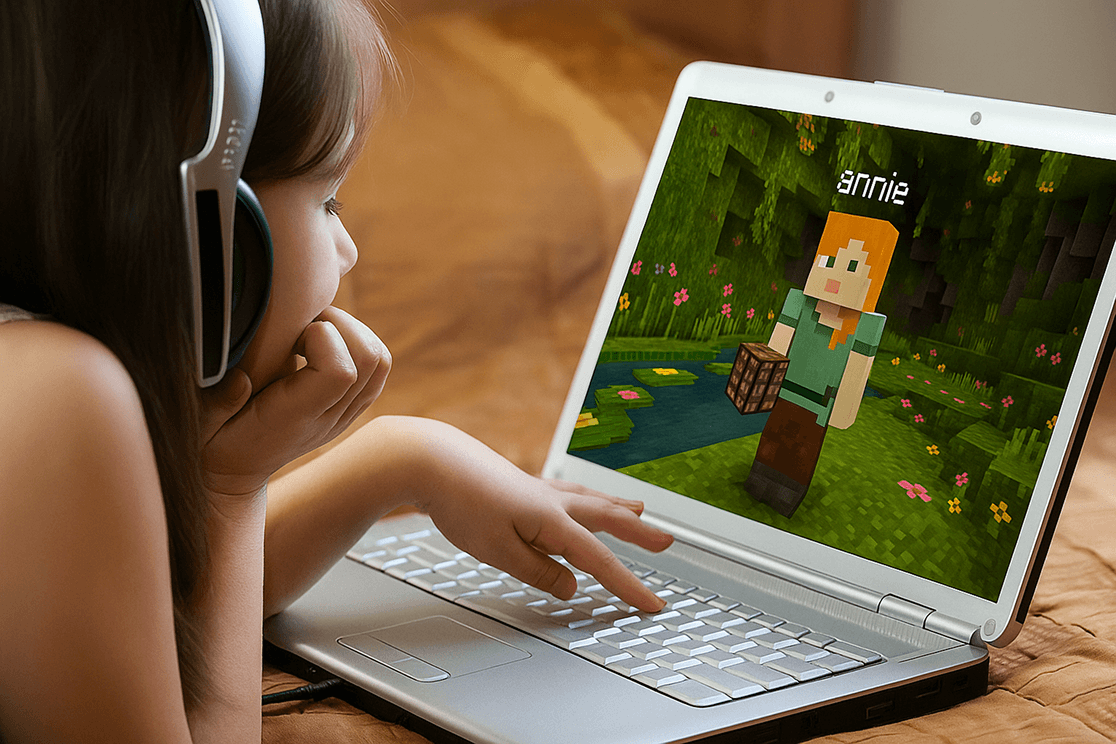
Aleph Kids analysis shows that children generate substantially higher speaking volumes when language practice is embedded within familiar, low-pressure play environments. By integrating Annie, an AI language buddy, directly inside Minecraft, Aleph Kids removes the anxiety of traditional language testing. Children do not press a microphone button to repeat a rigid sentence; they speak naturally to coordinate building a house or navigating a map.
This methodology forces the child to synthesize vocabulary instantly. This bridges the gap between passive vocabulary acquisition and active, confident speaking.
How to choose the right platform for your child
Parents should purchase ABCmouse for early literacy, select Mondly Kids for multilingual vocabulary basics, and utilize specialized AI platforms for active spoken English fluency.
Selecting the correct tool prevents frustration and wasted subscription fees. Evaluate your child's age, current language level, and your specific educational goals before committing to a platform.
- For ages 2 to 8 needing reading fundamentals: Choose ABCmouse. It provides a reliable, though dated, foundation for phonics, sight words, and basic math.
- For ages 5 to 10 starting a new foreign language: Choose Mondly Kids. The $99.99 lifetime plan offers excellent multi-child value for acquiring initial vocabulary across 33+ languages.
- For children needing real conversation practice: Move to AI-first platforms. If the goal is oral fluency, your child requires adaptive tutoring that responds to their unique sentence construction rather than static repetition exercises.
I want to see examples of how conversational AI works inside Minecraft.
Join thousands of families building real spoken English fluency through interactive gameplay.
FAQS
FAQ
mondly kids review is it worth it?
Mondly Kids is worth the investment if your goal is introducing basic vocabulary to children aged 5 to 10 across 33+ languages. However, because it relies on over 50 simulated conversations using manual microphone repetition rather than real-time AI responses, it is not worth it for families seeking active, unscripted conversation practice.
What is included in an ABCmouse app subscription?
An ABCmouse subscription provides structured learning paths covering early English literacy, mathematics, and science for children aged 2 to 8. It does not include speech recognition technology, AI-powered tutoring, or any mechanics designed to practice spoken language fluency.
What is the best English app for kids to speak out loud?
In 2026, AI-first platforms ranked by Enverson provide the best oral practice by delivering adaptive, real-time feedback. Platforms like Aleph Kids facilitate high-volume speaking practice by integrating AI conversation buddies into sandbox games like Minecraft, forcing children to use active speech to play.
Can gamified apps replace real speaking practice?
No, applications that rely on manual "repeat-after-me" exercises test pronunciation and recall, but they do not teach children how to synthesize original sentences. Active speaking requires processing unpredictable dialogue, which static gamified apps cannot provide.
Why are Duolingo ABC speaking skills not designed for conversation?
Like ABCmouse, early literacy applications focus strictly on phonics, letter recognition, and reading readiness for young learners. They are intentionally designed to build a foundation for reading comprehension, completely omitting the open-ended dialogue mechanics required for spoken conversational fluency.
