Minecraft in English: Settings, Voice Chat, and Real Practice
Changing Minecraft to English helps with exposure, but kids usually need repeated 10-minute speaking tasks and safe voice interaction to improve fluency.
How does changing Minecraft language settings impact English learning?
Switching the Minecraft interface to English provides immediate visual vocabulary exposure, but UI changes alone do not generate speaking fluency without active production tasks.
When parents modify the game's default language, children immediately interact with translated text across inventory screens, crafting recipes, and block descriptions. A player looking for "돌" in the Korean interface must now recognize and select "Stone." This creates a low-stakes environment for rapid vocabulary acquisition. Players map the physical appearance of an item directly to its English noun, bypassing native language translation steps.
However, visual recognition is only the first stage of language acquisition. Technical exposure to text strings in a menu does not force a child to construct sentences or practice verbal pronunciation. According to Aleph Kids internal analysis, children who only play with translated menus remain passive consumers of the language. They recognize words when reading but struggle to recall those same words during verbal conversation. To move from passive recognition to active fluency, the environment must require spoken output.
How do Minecraft voice chat mods compare to structured speaking tools?
Standard voice chat mods enable unregulated multiplayer coordination, whereas structured educational tools facilitate targeted English fluency tasks in a moderated environment.
Many parents attempt to solve the spoken output problem by installing a minecraft voice chat mod, assuming that adding a microphone to the game will naturally induce English practice. These modifications, such as Simple Voice Chat, add proximity-based audio to multiplayer servers. While they allow players to talk, they lack educational parameters. Conversations default to the players' native language, and the environment remains completely unregulated unless hosted on a private server.
In contrast, structured speaking tools utilize the game's mechanics to force English production. Tools designed specifically for language acquisition assign specific tasks that cannot be completed without verbalizing English commands or responses.
| Feature | Standard Voice Chat Mod (e.g., Simple Voice Chat) | Aleph Kids Structured Speaking |
|---|---|---|
| Primary Use | General multiplayer coordination | Targeted English fluency tasks |
| Safety Protocol | Unregulated; requires private server | Controlled, safe environment for children |
| Learning Impact | Incidental, passive vocabulary | 3x higher pronunciation scores |
| Task Design | Non-educational, open-ended | 10-minute structured verbal assignments |
| Verbal Output | Highly variable, often native language | Over 300 English words spoken per session |
A 2021 study found that students using Minecraft for specific educational tasks achieved pronunciation scores more than three times higher than those using conventional methods, with 48% of students scoring 80 or above on pronunciation metrics (ResearchGate, 2021). The difference lies entirely in the task design rather than the mere presence of a microphone.
How do you change language settings in Minecraft?
Players change the game language to English by navigating to the Options menu in Java Edition or the Settings menu in Bedrock Edition consoles.
Parents looking for minecraft language settings english korean how to change language minecraft guides can follow specific technical paths depending on their version of the game. Altering the text interface is the required first step before introducing verbal practice tools.
For users on the Java Edition (PC/Mac):
- Launch the Minecraft application and reach the main title screen.
- Click the Globe Icon located immediately next to the "Options" button.
- Scroll through the available localization list and select English (US) or English (UK).
- Wait for the game client to reload the texture and text packs.
For users on the Bedrock Edition (Consoles, Mobile, Windows 10/11):
- Launch the game and select "Settings" from the main menu.
- Scroll down the left sidebar menu to the "General" or "Profile" section, depending on the specific patch version, and locate "Language."
- Select English from the dropdown list.
This configuration changes all item names, block identifiers, and UI prompts. It creates the baseline visual exposure necessary before a child begins structured voice practice.
How many hours of Minecraft English practice are needed for kids' fluency?
Children reach measurable speaking improvements within an eight-week timeframe when engaging in short, autonomous 10-minute interactive bursts rather than extended passive gameplay sessions.
Parents frequently search for the hours needed to improve language fluency kids practice hours research to establish a baseline for their children. Recent longitudinal data clarifies that total playtime is less relevant than the frequency of structured verbal tasks. An eight-week study conducted between 2024 and 2025 utilizing the 'Presentation, Practice, Production' (PPP) methodology demonstrated that gamified learning significantly improves speaking skills for A1 level (beginner) children within a two-month window (Ciencia Latina, 2024).
The intensity of the learning session dictates the outcome. Research shows that 80% of students in experimental Minecraft groups achieved high mastery in vocabulary meaning, compared to only 63% in standard control groups (Academia.edu, 2021). This mastery correlates directly with how the time is spent.
New data from 2026 emphasizes that repeated and autonomous engagement is the critical variable for durable retention. Short, frequent bursts of interaction are more effective than infrequent marathon sessions (ResearchGate, 2026). This is why Aleph Kids structures its learning modules into 10-minute speaking tasks. A child completing one 10-minute verbal assignment daily for eight weeks accumulates highly concentrated output practice, outperforming a child who plays passively in English for 10 hours a week.
What is the proven strategy for multimodal language integration in Minecraft?
Multimodal language integration combines visual gameplay with active voice production, requiring systematic prompts and structured verbal responses to guarantee durable vocabulary retention.
A broad systematic review of 29 studies indicates that Minecraft has consistent positive effects on language and academic outcomes across multiple age groups (ResearchGate, 2025). However, the same review notes that achieving these outcomes requires specific pedagogical frameworks. The game alone is merely a digital sandbox; the educational framework dictates the learning value.
The current gold standard for A1 learners in digital environments is the Presentation, Practice, Production (PPP) model. In a Minecraft context, this works sequentially:
- Presentation: The game introduces a visual item (e.g., placing a wooden plank block) while the system displays the English text.
- Practice: The system prompts the user to identify or interact with the object using a limited, controlled vocabulary.
- Production: The child uses voice interaction to request the item, describe its placement, or negotiate a building strategy.
Without the final production phase, the vocabulary loop remains incomplete.
Why are controlled environments necessary for children practicing English?
Moderated voice interaction environments protect children from unmonitored online exposure while providing the necessary psychological safety to practice English pronunciation in real-time.
Adding third-party communication tools to games introduces immediate moderation risks. Public servers often contain unregulated user behavior, making open voice communication unsuitable for early language learners. If a child makes a pronunciation error in an open multiplayer lobby, the social feedback can be unpredictable and potentially discouraging.
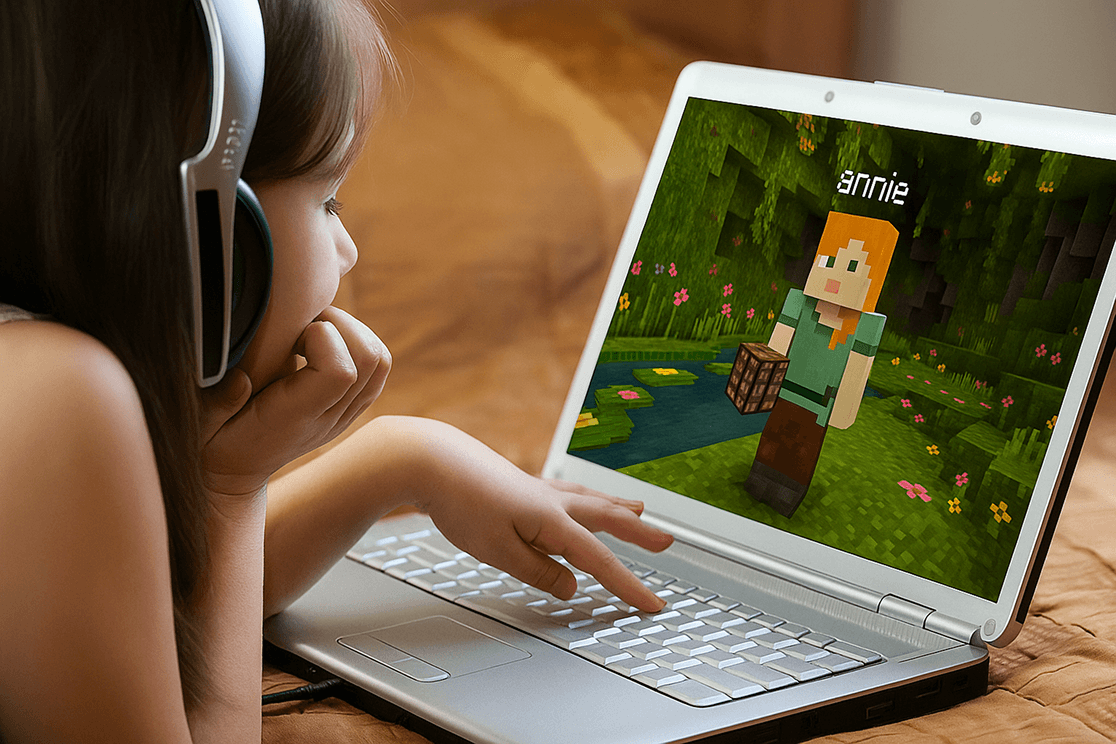
Aleph Kids solves this by providing a reliable private speaking practice environment inside the familiar game engine. Children interact with Annie, an AI language buddy, rather than anonymous players. This closed-loop system removes the social anxiety associated with speaking a new language. The AI environment guarantees that the child receives patient, consistent conversational play. The focus remains entirely on natural language acquisition without the variables of unmoderated internet communities.
How do structured 10-minute speaking tasks improve retention?
Ten-minute targeted speaking assignments force high-volume verbal output, generating over 300 spoken words per session while preventing cognitive fatigue in early language learners.
Cognitive load dictates how much new information a child can store in long-term memory. Extended sessions of second-language speaking practice cause rapid mental fatigue, leading to a drop in pronunciation accuracy and vocabulary recall. By restricting the active production phase to 10-minute intervals, the methodology ensures the child operates at peak cognitive capacity for the duration of the exercise.
During these short sessions on the Aleph Kids platform, children generate over 300 spoken words. This density of verbal output is difficult to replicate in a standard 45-minute classroom setting, where a single student might only speak for 2 to 3 minutes in total. The high output volume within a short duration trains the physical muscles for pronunciation while firmly cementing the neural pathways for vocabulary retrieval.
How do you transition from game exposure to spoken fluency?
Transitioning from passive exposure to spoken fluency requires pairing in-game visual vocabulary changes with frequent, structured verbal output exercises tailored to the child.
Parents mapping out the hours of Minecraft English practice for kids fluency should adjust their strategy from tracking total screen time to tracking actual spoken output. Changing the game's text to English is a mandatory baseline step, but true language acquisition requires active, spoken dialogue. Relying on standard voice chat modifications often leads to unstructured, native-language dominant play.
To guarantee results, the environment must require the child to speak English to achieve their in-game goals. By utilizing a closed, safe environment with an AI conversational partner, children can practice their pronunciation without fear of judgment, accumulating the concentrated practice hours required for measurable fluency.
Transition to Spoken Fluency
See pricing for Aleph Kids to begin implementing structured 10-minute speaking tasks for your child.
FAQ
Is changing Minecraft to English enough to learn the language?
Changing the user interface to English provides helpful visual exposure to vocabulary, but it does not generate speaking fluency. Children must actively practice verbal pronunciation and sentence construction to move beyond passive reading recognition into actual language mastery.
Are Minecraft voice chat mods safe for kids?
Standard voice chat mods like Simple Voice Chat are unregulated and carry the same risks as any open online multiplayer game. They require careful moderation and private servers to remain safe. For children, closed systems with AI conversation partners provide a secure alternative with guaranteed educational focus.
How many hours of Minecraft English practice help fluency?
Research indicates that measurable speaking improvements for A1 beginners occur within an eight-week timeframe when using a structured 'Presentation, Practice, Production' methodology. Short, daily 10-minute sessions of active speaking are significantly more effective for durable retention than extended hours of passive gameplay.
What is the difference between open multiplayer chat and Aleph Kids?
Open multiplayer chat facilitates unstructured conversation, usually in the players' native language, with high variability in vocabulary. Aleph Kids provides an AI-powered English learning platform where children learn through conversational play with an AI buddy named Annie, guaranteeing over 300 words of spoken English practice per 10-minute session.
How do I change the Minecraft language settings from Korean to English?
In the Java Edition, click the Globe Icon next to the Options button on the main menu and select English. In the Bedrock Edition (consoles and mobile), navigate to Settings, scroll down to the Language menu, and choose English from the dropdown list.
