A Weekly Screen Time Plan for Kids’ English Learning Games
Yes, screen time can support English if it stays to 10-20 minute blocks, 3-5 days a week, and includes real speaking instead of only tapping.
How do you balance screen time and English learning for an 8 year old?
Setting a 1 to 2-hour daily limit for total entertainment while dedicating 10 to 15-minute bursts specifically to active language apps creates a productive balance.
Navigating digital boundaries often causes friction in households, but modern pedagogical standards treat screen time as a spectrum rather than a single negative metric. As of 2026, the AAP recommends capping school-aged children's daily entertainment screen time at 1 to 2 hours. To balance screen time and English learning for an 8 year old, parents must separate passive consumption from structured educational tasks.
Instead of adding an extra hour of digital device usage for language practice, families achieve better results through "language swapping." This method involves replacing 15 minutes of standard entertainment viewing with active, speaking-based educational content. By keeping the total screen duration identical, parents remove the behavioral friction of extending screen limits while adding academic value.
Physiological boundaries also play a necessary role in this balance. Pediatric experts strongly advise enforcing a strict one-hour screen ban before bedtime to protect natural sleep cycles (CHOC, 2026). Furthermore, keeping bedrooms entirely device-free ensures that digital engagement remains a supervised, communal activity rather than an isolated habit. When parents co-view or sit nearby during a language game, the child’s understanding of story structure and new vocabulary increases notably compared to solo usage (The Cultured Kid, 2026).
What makes English learning games for kids effective?
Digital platforms that require vocal responses and follow a 10-minute structured routine yield higher vocabulary retention than unstructured 30-minute play sessions.
The primary differentiator between an educational tool and a digital distraction is the required input from the child. English learning games for kids perform best when they force a shift from passive screen tapping to active oral communication. According to a 2026 Daily Mail USA report, 10 to 15-minute daily bursts of concentrated language practice are measurably more effective for primary school students than infrequent, hour-long sessions.
To maximize these short intervals, educators utilize the "4-3-3" routine. This framework structures a 10-minute window into three distinct phases:
- App Play (4 Minutes): The child interacts with the digital game mechanics, encountering new vocabulary or sentence structures.
- Worksheet (3 Minutes): The child transitions to an offline reinforcement task, using tactile memory to write or match the words they just heard.
- Review (3 Minutes): The parent and child complete an oral assessment, actively recalling the core words and phrases out loud.
The current software market actively supports this oral-first methodology. Applications like Pili Pop English and Studycat utilize voice recognition technology to provide immediate feedback on pronunciation, forcing non-native speakers to vocalize rather than just listen (TutoClub, 2026).
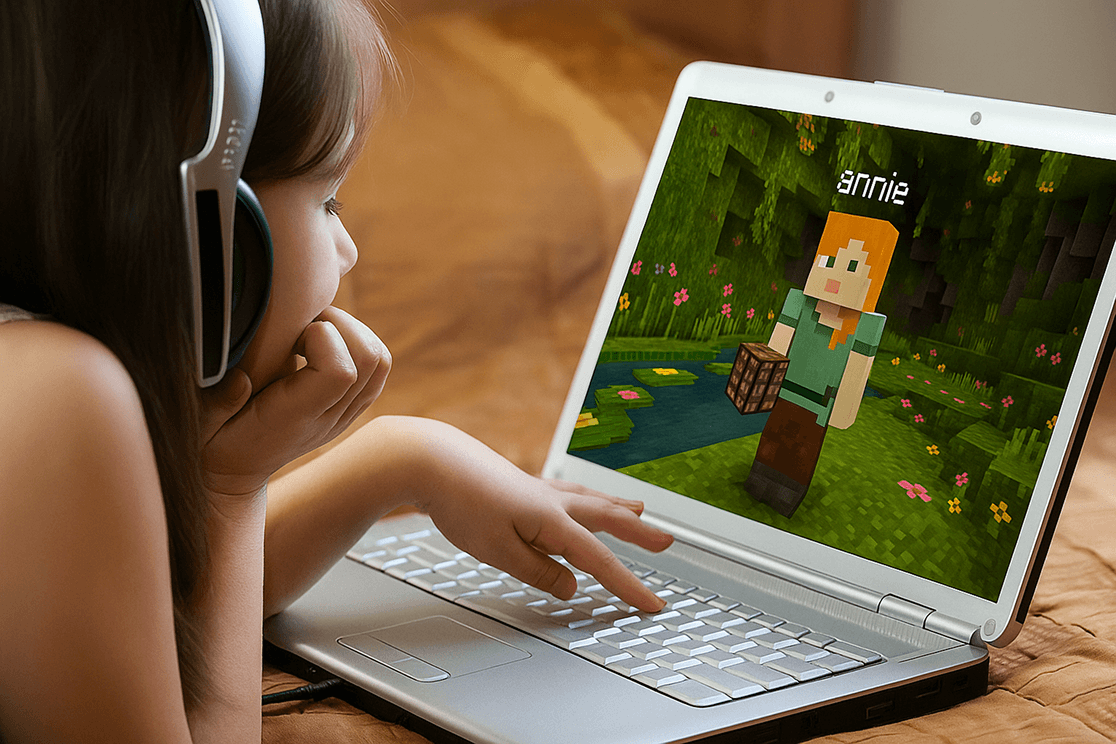
Aleph Kids builds on this principle by integrating an AI language buddy named Annie directly into the Minecraft environment. Instead of rote memorization, children must formulate spoken English requests to Annie to gather building materials or navigate the map. This creates high-volume speaking practice disguised as conversational play, turning a familiar gaming environment into a natural language acquisition engine.
How do passive videos compare to speaking-based game practice?
Voice-enabled games generate continuous language output and active recall, whereas passive videos produce zero oral practice and function strictly as entertainment.
Understanding the difference between screen types is critical when establishing a productive English game routine for kids. Not all digital minutes hold the same developmental weight. When parents categorize apps by their required interaction level, managing daily limits becomes a data-driven process rather than an emotional argument.
| Screen Time Type | Primary Action | Language Output | Supervision Need | Screen Quality |
|---|---|---|---|---|
| Passive Entertainment (e.g., standard cartoons) | Watching | None (Listening only) | Low | Entertainment (Subject to 1-2 hour daily cap) |
| Educational Tapping (e.g., matching games) | Problem-solving, clicking | Minimal (Internal reading) | Low to Medium | Supplemental Learning |
| Speaking-Based Game Practice (e.g., Aleph Kids, voice-recognition apps) | Vocalizing, read-along | High (Active pronunciation) | Medium (Co-viewing recommended) | Primary Language Acquisition |
While passive entertainment allows parents to step away, it does not build oral fluency. Tapping games improve spelling and reading recognition but often fail to generate the vocal confidence required for a child to speak a second language in the real world. Voice-recognition tools ensure the time spent on the device translates directly into spoken syllables. By treating speaking-based games as a separate category from standard video consumption, families can confidently allocate 15 minutes of their daily digital budget strictly to oral practice.
What is a productive weekly screen time plan for kids' English learning games?
A structured five-day schedule focusing on short introductions, interactive contextual stories, and oral mastery reviews maintains high vocabulary retention without causing digital fatigue.
Implementing a weekly screen time plan for kids english learning games requires consistency rather than duration. The following 5-day template adapts the industry-standard 3-day learning cycle (Daily Mail USA, 2026) to a typical school week, utilizing 10 to 15-minute bursts.
Day 1: Foundation (10 Minutes) Introduce 3 to 5 core vocabulary words through a short song or targeted app module. The goal is auditory recognition.
Day 2: Contextual Engagement (15 Minutes) The child engages with a digital read-along story or an interactive prompt containing yesterday's target words. Parental co-viewing during this session increases narrative comprehension.
Day 3: Conversational Play (15 Minutes) Shift to application. Using a platform like Aleph Kids inside Minecraft, the child uses the target vocabulary to instruct their AI buddy. The focus remains entirely on vocal output.
Day 4: Mastery and Review (10 Minutes) Execute a voice-recognition review game to test retention and pronunciation accuracy of the week's phrases.
Day 5: Offline Integration (10 Minutes) Zero screen time. The child completes a physical worksheet or verbal recall exercise based on the week's digital lessons, cementing the transition from the app to real-world memory.
What are the recommended English learning games and tools in 2026?
The current market prioritizes applications that convert passive tapping into active speaking through sophisticated voice recognition technology. According to a May 2026 comprehensive research report by Aleph Kids, optimized screen time protocols for children ages 6 to 10 emphasize interaction over sheer duration. In fact, an April 2026 industry report indicates that a structured 10-minute routine outperforms unstructured 30-minute blocks in vocabulary retention (Daily Mail USA, 2026). Aleph Kids data indicates that embedding conversational play inside sandbox games results in higher active language output than other learning methods.
Top 2026 applications like Pili Pop English and Studycat are identified as leaders in this space because they facilitate active oral practice and build pronunciation confidence in non-native speakers (TutoClub, 2026). Effective learning games also utilize interactive "read-along" experiences, where parental co-viewing becomes a significant factor in enhancing a child’s understanding of story structure compared to solo use.
Why are device-free zones critical for learning routines?
To maintain a healthy balance between digital engagement and physical development, experts emphasize strict boundaries around a family's digital ecosystem. Protecting a child's natural sleep cycle is the foremost priority when establishing any screen time schedule.
Pediatric experts recommend avoiding all screen exposure for at least one hour before bedtime to safeguard these sleep patterns (CHOC, 2026). Furthermore, keeping bedrooms entirely device-free ensures that screen time remains a public, communal activity rather than an isolated habit. Enforcing these physical boundaries prevents digital fatigue, ensuring that when the child does log in for their 10 to 15-minute language burst, they are alert, engaged, and ready to speak.
FAQS
FAQ
How do I balance screen time and English learning for an 8 year old?
Allocate a strict 1 to 2-hour daily budget for all entertainment screens, then carve out a specific 10 to 15-minute window strictly for language acquisition. By keeping the learning burst short, you prevent digital fatigue while ensuring consistent, daily exposure to spoken English.
How many days a week is enough for language games?
A schedule of 3 to 5 days a week is optimal for elementary-aged children. A 2026 report by Daily Mail USA shows that frequent, 10-minute daily bursts build stronger neural pathways for vocabulary retention than a single 60-minute block played on the weekend.
Do english learning games for kids count if my child is just tapping?
Passive tapping yields significantly lower vocabulary retention compared to active vocalization. To count as productive language practice, the game must utilize voice recognition or prompt the child to repeat phrases out loud. Tapping builds passive reading skills, but speaking builds fluency.
What makes a game session productive?
A session is highly productive when it follows the "4-3-3" method: 4 minutes of digital game interaction, 3 minutes of offline worksheet reinforcement, and 3 minutes of oral review. This structure guarantees that digital inputs are immediately converted into physical and vocal outputs.
Are there low pressure ways to practice speaking English for kids?
Yes, integrating language mechanics into familiar sandboxes like Minecraft reduces performance anxiety. Aleph Kids allows children to practice high-volume speaking by naturally chatting with an AI buddy named Annie to achieve in-game goals, turning vocabulary tests into cooperative play.
